 how-to
5 Non-Surgical Facial Balancing Steps for a Tired Look
Last Updated: October 30, 2026
Quick Summary
Non-surgical facial balancing treats a tired appearance as a structural problem by restoring lost volume with dermal fillers and tightening lax skin with energy-based devices. We assess midface support, tear trough depth, and jawline definition first, then plan treatment around your anatomy rather than a package.
- A tired look often reflects volume loss, bone remodeling, and shadow patterns rather than skin alone.
- We assess the face in motion and at rest, since static photos miss how tissue behaves.
- Fillers work best in the midface, temples, and jawline, and least predictably under the eyes.
- Energy-based devices tighten skin by heating tissue to trigger collagen remodeling, addressing laxity not volume.
- Swelling and bruising peak in days 1 to 3, and most residual swelling resolves by weeks 2 to 4.
Table of Contents
- Why a Tired Appearance Is a Structural Problem, Not Just a Skin Problem
- What a Facial Balancing Consultation Should Cover
- Facial Balancing With Dermal Fillers: What Each Area Can and Cannot Fix
- Energy-Based Tightening for Natural-Looking Facial Rejuvenation
- Facial Balancing Risks and Recovery: What to Expect Week by Week
- How Long Results Last and What Changes Them
- Scheduling Your Facial Balancing Consultation at Mirelle
- Frequently Asked Questions
Why a Tired Appearance Is a Structural Problem, Not Just a Skin Problem
A tired appearance rarely comes from skin alone. It usually reflects volume loss, bone remodeling, and shadow patterns that change how light hits the face. Non-surgical facial balancing is best assessed as a structural question first, not a surface one.
Facial aging moves in layers. Fat pads in the midface descend and thin. The jawline loses the support that once held it sharp. Hollows under the eyes deepen. These shifts create shadows, and shadows read to the brain as fatigue, even when you slept well. Softening these transitions often requires a multi-faceted approach, as the techniques for hiding under eye bags can provide immediate relief while you consider more permanent structural adjustments.
That distinction matters because creams and surface treatments cannot restore lost volume or lift a descended fat pad. They can improve texture and tone. They cannot rebuild architecture.
If jawline laxity is your main concern, our guide on how to fix a sagging jawline without surgery breaks down the structural options in more detail.
What a Facial Balancing Consultation Should Cover
A good facial balancing consultation starts with assessment, not a syringe. The first visit should map where volume has been lost, where shadowing comes from, and whether you are a suitable candidate at all.
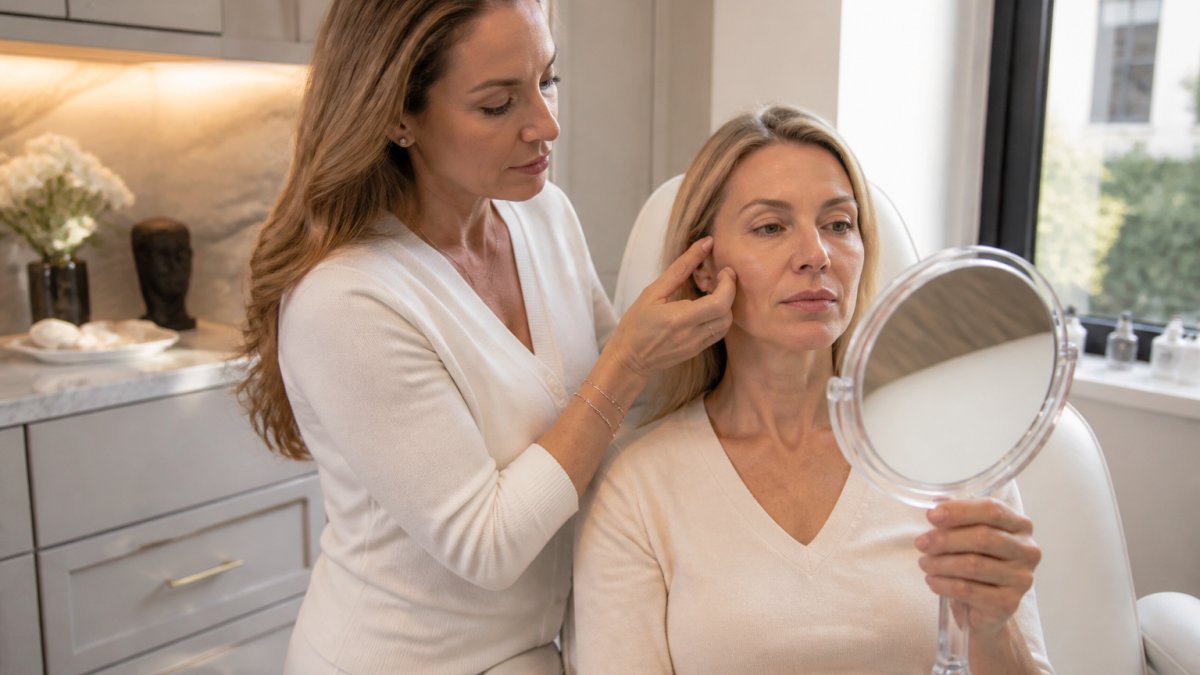
The Assessment: Mapping Volume Loss and Shadow Patterns
We assess the face in motion and at rest. Static photos miss how tissue behaves when you smile, speak, or look down. Lighting matters too, since overhead light exaggerates hollows that disappear in softer light.
The assessment covers:
- Midface volume and cheekbone support
- Tear trough depth and lower eyelid position
- Jawline definition and pre-jowl hollowing
- Skin quality, thickness, and laxity
- Facial asymmetry, which is common and usually normal
Patient Selection: Who Is a Candidate and Who Is Not
Not everyone with a tired look is a filler candidate. Some faces need tightening, not volume. Others need both, staged over time.
We are cautious with patients who have active skin infection, uncontrolled autoimmune flares, or a history of poor filler outcomes elsewhere. Pregnancy and breastfeeding are reasons to wait. We also screen for body dysmorphic patterns, because a structural procedure will not resolve a concern that is not structural.
Honest patient selection protects outcomes more than any product choice.
Facial Balancing With Dermal Fillers: What Each Area Can and Cannot Fix
Facial balancing with dermal fillers restores volume where the face has lost support. It works best in the midface, temples, and jawline. It works least predictably in the delicate under-eye area.
Different areas behave differently:
- Temples: Restores upper facial width and softens a gaunt look. Predictable.
- Cheeks and midface: Lifts the appearance of the lower face by restoring support. Strong candidate area.
- Jawline and chin: Improves contour and projection. Results depend on bone and skin quality.
- Under-eye hollows: Technically demanding. Thin skin and lymph drainage make lumps and bruising more likely.
Fillers can look lumpy or bumpy, so this is not a risk-free approach. Individual results vary.
You can review the dermal fillers service page for how we structure treatment planning.
Energy-Based Tightening for Natural-Looking Facial Rejuvenation
Energy-based devices tighten skin by heating tissue to trigger collagen remodeling (The Landscape of Radiofrequency Technology for Skin Rejuvenation). They address laxity, not volume. Used together with fillers, they support natural-looking facial rejuvenation across more than one layer.
Schedule Your Personalized Consultation →
Advanced Density® Dual-Energy RF is designed to combine superficial tissue contraction with deeper collagen redensification. Results vary, and the goal is a firmer, better-supported look rather than a pulled one.
Candidacy is determined during a clinical consultation, and patients with significant sagging may see only modest improvement.
If you are comparing technologies, our breakdown of Density RF versus other skin tightening options explains how the devices differ, and the skin tightening page covers candidacy and next steps.
Facial Balancing Risks and Recovery: What to Expect Week by Week
Most facial balancing risks are temporary and manageable. Bruising, swelling, and tenderness are the common ones (the FDA). Lumps, asymmetry, and vascular complications are uncommon but real.
Recovery generally follows this pattern:
| Timeframe | What to Expect | Practical Guidance |
|---|---|---|
| Days 1-3 | Swelling and bruising peak | Avoid strenuous exercise and alcohol |
| Days 4-7 | Swelling settles, contour emerges | Light activity is fine |
| Weeks 2-4 | Most residual swelling resolves | Assess results with your clinician |
| Weeks 4-12 | Collagen remodeling continues with energy devices | Skin quality firms gradually |
Watch out: pressing or massaging a treated area without instruction can move product or worsen swelling. Follow your clinician's aftercare directions exactly.
How Long Results Last and What Changes Them
Filler longevity varies by product, area, and metabolism. Filler longevity varies by product and individual. Energy-based tightening results build over months and are maintained with periodic sessions.
Factors that shorten results:
- High metabolic rate and active lifestyle
- Significant weight change
- Smoking
- Sun exposure without protection
- Poor skin quality at baseline
Maintenance is planned around individual anatomy and response.
Scheduling Your Facial Balancing Consultation at Mirelle
Facial balancing for a tired appearance works best when the plan matches your structure, your skin, and your goals. That requires a real assessment, not a package.
At Mirelle Institute for Longevity & Regenerative Medicine, Dr. Corina Ianculovici, DNP, FAAMFM, ABAAM-HP, AGNP leads a clinician-led approach that pairs architectural facial balancing with functional and metabolic medicine. You can read about the Mirelle Method to understand how we approach planning before treatment.
A tired look that persists despite good sleep and skincare usually has a structural cause. Identifying it correctly is the difference between a natural result and an overfilled one. Mirelle Institute for Longevity & Regenerative Medicine offers Advanced Density® Dual-Energy RF and clinician-led assessment under Dr. Corina Ianculovici, DNP, FAAMFM, ABAAM-HP, AGNP. Consult with Mirelle Institute for Longevity & Regenerative Medicine to build a plan grounded in your anatomy rather than a trend.
Frequently Asked Questions
Can facial balancing help you look less tired?
It can reduce the structural shadows that read as fatigue: hollowing under the eyes, flattened cheekbones, and volume loss along the jawline. Restoring support in those areas softens the dark hollows and downward lines that make a face look drained. It does not treat the causes of fatigue itself, such as poor sleep, anemia, thyroid dysfunction, or menopause-related hormonal shifts. A clinician-led consultation should screen for those drivers before recommending any treatment.
How long do non-surgical facial balancing results last?
Duration depends on the technique and the product. Filler duration depends on the product used, and energy-based collagen remodeling builds over months. Individual results vary with metabolism, treatment area, and lifestyle. Your provider should give you a realistic timeline for your specific plan rather than a single blanket number.
What are the risks and limitations of facial balancing with dermal fillers?
Fillers can look lumpy or bumpy, and an uneven result is a recognized limitation of nonsurgical facial balancing. Other risks include bruising, swelling, and, rarely, vascular complications that require urgent care. Fillers restore volume but do not tighten loose skin, so severe laxity may need an energy-based approach or surgical referral. Choosing an experienced clinician and starting conservatively lowers risk but does not eliminate it.
How can I choose a qualified provider for facial balancing in Manasquan, NJ?
Look for a clinician who assesses your full face rather than selling a single syringe, explains FDA-approved versus off-label use, and documents a plan you can decline at any point. At Mirelle Institute for Longevity & Regenerative Medicine, Dr. Corina Ianculovici, DNP, FAAMFM, ABAAM-HP, AGNP, leads consultations with over 20 years of clinical experience and pairs aesthetic planning with functional and metabolic review. Ask about credentials, complication protocols, and what happens if you are not a candidate.