 how-to
How to Prepare for a Hormone Blood Test: A Step-by-Step Guide
Last Updated: November 1, 2026
Quick Summary
To prepare for a hormone blood test, confirm with your clinician whether fasting is required, since rules vary by test, and draw at a consistent morning time. Review all medications and supplements with your clinician, never stopping a prescription on your own, and note your cycle day if you still menstruate.
- Morning is the default draw time because cortisol and male testosterone run higher then.
- Many tests, including estradiol, progesterone, TSH and FSH, do not require fasting.
- Biotin is well known to interfere with certain immunoassays, so ask about pausing it.
- Many clinicians time female testing to cycle day 3 for baseline FSH, LH and estradiol.
- Avoid alcohol, intense exercise and late nights in the 24 hours before your draw.
Table of Contents
- Why Preparation Makes or Breaks a Hormone Blood Test
- Hormone Blood Test Fasting: When It Matters and When It Does Not
- The Best Time of Day for a Hormone Blood Test
- Hormone Test Preparation: Medications and Supplements to Review
- Menstrual Cycle Timing for Hormone Testing
- What to Avoid in the 24 Hours Before Your Draw
- Step-by-Step: Your Day-of Checklist
- Scheduling Your Hormone Testing Consultation
- Frequently Asked Questions
Why Preparation Makes or Breaks a Hormone Blood Test
A hormone blood test is only as good as the conditions under which the sample was drawn. Timing, fasting status, medications, and cycle day all change what the numbers mean, which is why preparation is not a formality.
Here is the uncomfortable truth most lab handouts skip: a hormone result is a snapshot, not a verdict. A review of testing pitfalls in the Journal of Clinical Pathology found that sex-hormone testing in women is difficult to interpret, and that valid conclusions require correctly timed tests and a rational, sequential approach (Smellie et al., testing pitfalls in sex hormone testing). In plain terms: a poorly prepared draw can send you and your clinician chasing a problem that does not exist.
Below, we walk through how to prepare, step by step, so your results reflect your physiology as accurately as possible.
Hormone Blood Test Fasting: When It Matters and When It Does Not
There is no single fasting rule for every hormone blood test. Cleveland Clinic advises asking your provider whether eating and drinking are allowed before your draw, and notes that both medicines and supplements can change results (Cleveland Clinic on hormone testing). Follow the instructions tied to your specific test, not a general assumption.
Tests That Typically Require Fasting
Some panels are sensitive to recent food intake. These commonly come with a fasting instruction:
- Insulin and glucose together, often paired with hormone panels
- Cortisol drawn in the morning, where timing and fasting are both specified
- Lipid panels, frequently ordered alongside metabolic testing
- Growth hormone and IGF-1, when ordered fasting by your clinician
Tests Where Fasting Is Not Required
Many hormone tests do not require fasting at all:
- Estradiol and progesterone draws
- Testosterone in most standard orders
- TSH and free T4, unless your clinician says otherwise
- FSH and LH
The practical takeaway: read your order, then confirm with the ordering clinician. Guessing in either direction can cost you a repeat draw.
The Best Time of Day for a Hormone Blood Test
Morning is the default for most hormone draws, and for good reason. Cortisol peaks shortly after waking and declines through the day. Testosterone in men also tends to run higher in the morning. Drawing at a consistent time makes results comparable from one test to the next.
For women, the best time of day depends on the hormone and the question being asked. Progesterone and estradiol are interpreted against cycle day, not clock time. Cortisol is the exception where the clock matters most, and your clinician will usually specify an early morning window. Navigating these specific timing requirements often requires professional guidance to ensure your results are interpreted correctly, which is why it is essential to find a hormone specialist who understands the nuances of your endocrine health.
Two practical rules:
- Draw at the same time each time. Consistency beats perfection.
- Do not shift your sleep schedule the night before just to hit an early slot.
If your results suggest a thyroid issue, timing is only part of the picture. We explain that gap in our article on why traditional medicine misses autoimmune thyroid disease.
Hormone Test Preparation: Medications and Supplements to Review
Never stop a prescribed medication on your own before a hormone blood test. Instead, bring a complete list to your clinician and let them decide what, if anything, should be paused and for how long. This is one of the most common mistakes we see.
Medications That Can Shift Results
Certain drugs can alter hormone readings, and the effect depends on the medication and the test:
- Birth control pills and hormonal contraceptives, which change endogenous hormone levels
- Bioidentical or conventional hormone therapy, which shows up in the result by design
- Corticosteroids, which can affect cortisol and other readings
- Thyroid medication, where dose timing relative to the draw matters
- Opioids and some antipsychotics, which can influence sex hormones
Your clinician may ask you to pause a supplement but rarely a necessary prescription. That decision belongs to them, not to a general guide.
Supplements and Botanicals That Interfere
Supplements are not neutral. Several can shift hormone readings:
Schedule Your Personalized Consultation →
- Biotin, which is well known to interfere with certain immunoassays
- DHEA, which can raise measured androgen levels
- Saw palmetto and other botanical blends marketed for hormonal support
- High-dose vitamin C and herbal extracts, depending on the assay
Tell your clinician about everything you take, including powders, teas, and gummies.
Menstrual Cycle Timing for Hormone Testing
Cycle day is not a detail for women. It is the difference between a meaningful result and a misleading one. For anyone still menstruating, many clinicians time testing to a specific cycle day, and Labcorp's patient guidance for its custom female hormone test recommends cycle day 3 for that panel (Labcorp custom female hormone test guidance).
A practical framework:
- Day 3 testing is common for baseline FSH, LH, and estradiol
- Mid-luteal testing, roughly day 21 in a 28-day cycle, is used to check progesterone
- Irregular cycles may call for a different approach, sometimes with repeat draws
- Perimenopause makes timing less predictable, so your clinician may adjust the plan
Menopause is not a single-hormone event, and testing one hormone in isolation rarely tells the full story. Our article on why menopause is not a single hormone problem explains the broader hormonal context.
What to Avoid in the 24 Hours Before Your Draw
The day before your hormone blood test is where small choices add up. None of these will ruin a result on their own, but together they can blur the picture.
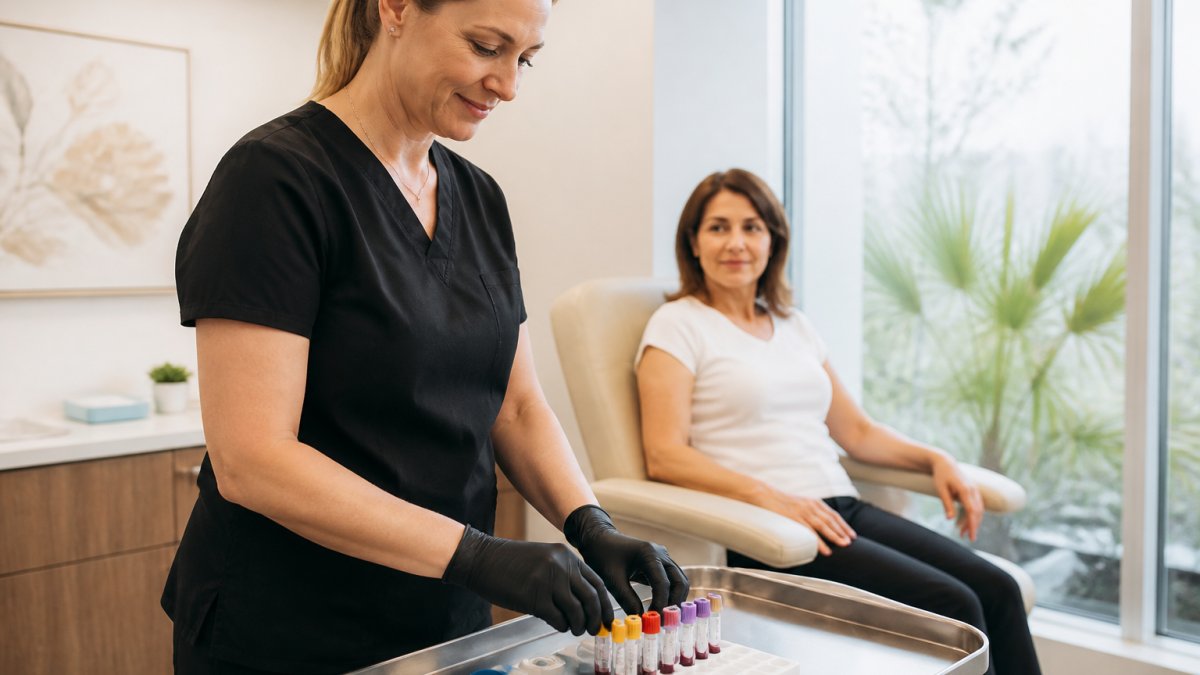
What to skip or limit:
- Alcohol, which can affect liver processing and hormone readings
- Intense exercise, which can shift cortisol and testosterone temporarily
- Biotin supplements, ideally for several days, per your clinician's guidance
- Late nights and poor sleep, which raise cortisol
- Skipping or doubling medications without instruction
Watch out: stopping a prescribed medication on your own before a draw can cause a hormone flare or withdrawal that looks like a new problem. Ask first.
Step-by-Step: Your Day-of Checklist
Use this as a quick reference the morning of your appointment. Print it, or keep it on your phone.
- Confirm the time window with the lab or your clinician
- Follow the fasting instruction exactly as written on your order
- Drink water unless told otherwise; hydration makes the draw easier
- Take only the medications your clinician approved for that morning
- Skip coffee until after the draw if fasting is required
- Bring your medication and supplement list
- Note your cycle day if you are still menstruating
- Wear short sleeves or a loose sleeve for easy access
- Arrive a few minutes early and sit calmly before the draw
- Ask the phlebotomist to label and handle tubes per protocol
| Situation | What to Do | Why It Matters |
|---|---|---|
| Fasting order | Water only until draw | Keeps metabolic markers clean |
| Morning cortisol | Draw within the stated window | Matches the reference range |
| On hormone therapy | Tell the phlebotomist | Result is interpreted differently |
| Still menstruating | Note your cycle day | Timing changes interpretation |
| Taking biotin | Ask about pausing | Reduces assay interference |
A calm, hydrated, well-prepared draw is easier on you and cleaner for the lab.
Scheduling Your Hormone Testing Consultation
Preparation is the easy part. Interpretation is where a clinician-led approach earns its keep. At Mirelle Institute for Longevity & Regenerative Medicine, Dr. Corina Ianculovici, DNP, FAAMFM, ABAAM-HP, AGNP, is a clinician-led resource for interpreting hormone results in context alongside symptoms, medications and goals. Readers who prefer remote care can review the advantages of telemedicine for consultations and follow-up.
If you are new to this model of care, our guide on what a functional medicine doctor is explains how it differs from a standard visit. And if testing leads to hormone therapy, our article on how long hormone replacement therapy takes to work sets realistic expectations.
A hormone panel is only as useful as the preparation behind it. If you want your results read by a clinician who looks at the whole picture, Mirelle Institute for Longevity & Regenerative Medicine can help. Dr. Ianculovici brings over 20 years of clinical experience and an approach that combines functional endocrinology with metabolic optimization and regenerative care. Get started with Mirelle Institute for Longevity & Regenerative Medicine and schedule a personalized consultation to build a testing plan that fits your body and your goals.
Frequently Asked Questions
Do you need to fast before a hormone blood test?
Not always. Fasting requirements depend on the specific test. A standalone estradiol or testosterone test often does not require fasting, but panels that include insulin, glucose, or a lipid profile usually do. Ask your provider whether eating and drinking are allowed before any hormone test. Follow the written instructions for your exact panel rather than assuming every hormone blood test requires an overnight fast.
What should you avoid before a hormone blood test?
Avoid strenuous exercise, alcohol, and major changes to your sleep schedule in the 24 hours before your draw. These can shift cortisol, insulin, and reproductive hormone levels. Also skip any new supplements or high-dose biotin in the days prior, since biotin can interfere with immunoassay-based tests. If you smoke, try not to smoke on the morning of the test, as nicotine can affect cortisol and other markers.
Should I take my medications before hormone testing?
Do not stop or delay any prescribed medication without speaking to your clinician first. Some drugs, including oral contraceptives, glucocorticoids, and certain antipsychotics, can alter hormone results. Your provider may adjust timing or note the medication on the lab requisition. Bring a complete list of prescriptions, over-the-counter drugs, and supplements to your visit so the ordering clinician can interpret results in context.
Does menstrual cycle timing affect hormone blood test results?
Yes. In women who are still menstruating, cycle day changes estradiol, progesterone, LH, and FSH substantially. Correctly timed testing and a sequential approach are important for valid interpretation in women who are still menstruating. Postmenopausal women and men do not need cycle-based timing, but morning draws are still preferred for consistency.