 ultimate-guide
How to Fix a Sagging Jawline Without Surgery
Table of Contents
- What Causes a Sagging Jawline and Skin Laxity
- Non-Surgical Jowl Reduction: What Actually Works
- Radiofrequency Skin Tightening for Face: How It Compares
- Ultrasound, Lasers, and Microneedling: Energy-Based Options
- Neuromodulators and Dermal Fillers: Softening Downward Tension
- Metabolic Optimization for Skin Health and Jawline Definition
- At-Home Methods vs. Clinical Treatments
- Costs, Maintenance, and Choosing a Qualified Provider
- Frequently Asked Questions
Last Updated: October 22, 2026
What Causes a Sagging Jawline and Skin Laxity
A sagging jawline results from collagen and elastin loss combined with shifting facial fat and bone, not a single "aging" event. At Mirelle Institute for Longevity & Regenerative Medicine, we explain that the jawline rarely fails for one reason, it fails in layers.
Three forces drive it: collagen and elastin production declines with age, so skin loses its snap; facial fat pads descend and thin, removing the scaffolding that held the lower face taut; and bone resorption along the jaw and chin reduces the frame underneath.
Collagen, Elastin, and the Loss of Facial Support
Collagen gives skin its tensile strength; elastin lets it stretch and spring back. Both decline gradually and are affected by sun exposure, smoking, and blood sugar swings. When they thin, the skin over the jaw can no longer resist gravity.
Facial support is architectural: skin sits on fat, fat sits on bone, and the jawline is where all three meet.
Non-Surgical Jowl Reduction: What Actually Works
Non-surgical jowl reduction works best when it matches the treatment to the layer that has failed. No single device or injectable reverses all three causes; a realistic plan combines tightening, support, and tension management.
Here is how we think about matching options to the problem:
| What has changed | Best-fit approach | What it can and cannot do |
|---|---|---|
| Mild skin laxity, good bone support | Energy-based tightening | Tightens skin; will not rebuild lost volume |
| Deflated mid-face, descended fat | Dermal fillers or biostimulators | Restores support; does not tighten loose skin |
| Downward pull from jaw muscles | Neuromodulators | Softens tension; modest lift, not a facelift |
| Moderate laxity plus texture | RF microneedling | Improves texture and firmness; gradual results |
The honest framing: these are facial rejuvenation tools, not facelift alternatives for advanced laxity. For mild to moderate laxity with reasonable skin quality, the combination can produce visible, natural improvement in jawline definition; for significant skin excess, surgery remains more definitive.
Radiofrequency Skin Tightening for Face: How It Compares
Radiofrequency skin tightening for the face delivers controlled heat into the dermis to stimulate collagen production and, at higher energies, contract tissue. It sits mid-spectrum: more structural than topical skincare, less dramatic than surgery.
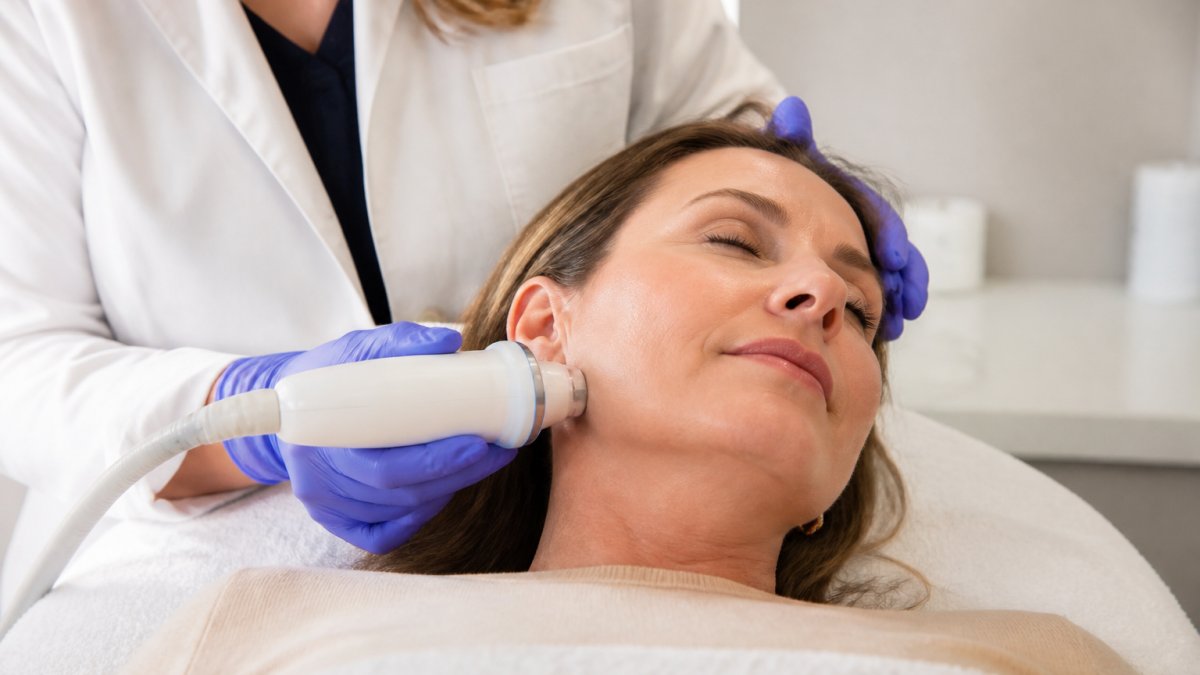
Radiofrequency fits mild to moderate laxity along the jawline and lower face because it works on the skin's own collagen rather than adding volume.
Technology choice matters here. Our Advanced Density® Dual-Energy RF is designed for two effects at once: immediate superficial tissue contraction and deeper volumetric collagen redensification, so a patient may see early firmness alongside gradual structural change over the following months.
Ultrasound, Lasers, and Microneedling: Energy-Based Options
Energy-based treatment is not one category but a family of devices differing in energy type, depth, and what they can realistically change. Matching the device to the failed layer is the whole game, and the evidence for each is uneven. Here is how the main options compare.
Ultrasound Skin Tightening
Focused ultrasound delivers energy below the dermis to deeper structural layers, including the superficial musculoaponeurotic system (SMAS) and, depending on the device, the platysma. Coagulative heating triggers a wound-healing response and collagen remodeling at depth, the same layers a surgeon addresses, without excision.
- Best fit: mild to moderate laxity with enough subcutaneous tissue to transmit and respond to energy.
- Typical course: a single session for many microfocused ultrasound protocols, with a repeat at 12-18 months as maintenance.
- Downtime: minimal to a few days of mild swelling or tenderness; occasional transient numbness.
Laser Treatments
Laser treatment is primarily a resurfacing tool. Ablative and non-ablative fractional lasers remove or heat columns of tissue to improve texture, tone, and dyschromia, and the resulting collagen response can secondarily improve firmness. The trade-off is downtime: non-ablative fractional lasers typically need several days of redness across three to five sessions, while ablative fractional lasers can involve a week or more of recovery and carry risks in darker skin tones if the wrong device is used.
- Best fit: laxity accompanied by sun damage, texture, or pigment concerns.
- What it will not do: lift descended fat pads or correct significant skin excess. If texture is not a concern, a tightening device is usually the better-targeted choice.
Radiofrequency Microneedling
Radiofrequency microneedling pairs controlled micro-injuries with heat at a set depth, driving collagen and elastin remodeling in the dermis while improving texture. It sits between surface resurfacing and deeper tightening.
- Typical course: three to four sessions spaced four to six weeks apart, with maintenance every 12-18 months.
- Downtime: one to three days of redness and mild swelling; pinpoint marks that fade.
- Best fit: mild to moderate laxity plus texture or pore concerns along the jawline and lower face.
Thread Lifts
A thread lift places absorbable barbed sutures under the skin to mechanically reposition tissue. It is the most surgical-adjacent non-surgical option, and the evidence is weakest: results vary widely by operator and technique, duration is measured in months rather than years, and risks include dimpling, visible threads, and asymmetry.
- Best fit: a narrow group of patients with mild descent who want a short-term mechanical lift and understand the limitations.
- What it is not: a substitute for collagen remodeling or a durable facelift. Many experienced clinicians reserve it for specific cases rather than first-line use.
How to Compare the Evidence Honestly
Evidence strength is not equal across this family. Energy-based tightening and RF microneedling have the most consistent support for modest, measurable improvement in firmness and texture in selected patients. Laser resurfacing has strong evidence for texture and pigment, weaker for lifting. Thread lifts have the most variable evidence and highest operator dependence. None durably corrects significant laxity, and any claim that a device "replaces surgery" is marketing, not clinical.
Neuromodulators and Dermal Fillers: Softening Downward Tension
Neuromodulators and dermal fillers address the jawline from two directions, and neither is a tightening device. Neuromodulators such as Botox, Dysport, and Daxxify relax specific muscles; in the lower face, carefully placed doses can soften the downward tension that pulls on the jawline, producing a subtle lift rather than a reshape.
Dermal fillers and biostimulators like Sculptra restore facial support by rebuilding lost volume. When the mid-face is re-supported, the lower face often looks less heavy. The skill is restraint: overfilling creates the exact "done" look patients fear.
Metabolic Optimization for Skin Health and Jawline Definition
Metabolic optimization for skin health is the piece most aesthetic guides skip. Skin is a high-turnover organ that responds to blood sugar, inflammation, sleep, and hormonal status. Collagen cross-links under chronic high glucose, and elastin degrades faster with systemic inflammation.
In perimenopause or menopause, hormonal shifts affect skin thickness, hydration, and fat distribution alongside energy and mood. At Mirelle Institute for Longevity & Regenerative Medicine, we pair aesthetic treatment with functional endocrinology so the plan addresses skin changes and underlying drivers together.
At-Home Methods vs. Clinical Treatments
At-home methods support skin health but do not reverse structural laxity. They are worth doing, but they are maintenance, not correction.
- Sun protection daily. UV exposure is the largest controllable driver of collagen breakdown.
- Topical retinoids. Supported for improving skin texture and supporting collagen over time.
- Consistent sleep and protein intake. Both support the skin's repair cycle.
Clinical treatments reach depths that topicals cannot. The realistic split: home care protects what you have, and clinical care rebuilds what has been lost.
Costs, Maintenance, and Choosing a Qualified Provider
Non-surgical jawline treatment is almost always a series with maintenance, not a one-time purchase. Pricing depends on the specific modalities chosen, the number of sessions required, and individual patient needs.
| Modality | Typical per-session range (USD) | Typical course | Maintenance interval |
|---|---|---|---|
| Neuromodulator (lower face) | $200-$600 per visit | Every 3-4 months | Ongoing |
| Dermal filler (mid-face support) | $700-$1,200 per syringe | 1-3 syringes, reassessed at 2-4 weeks | 9-18 months, varies by product |
| Biostimulator (e.g., poly-L-lactic acid) | $800-$1,500 per vial | 2-3 sessions, 4-6 weeks apart | 1-2 years |
| Radiofrequency skin tightening | $600-$1,500 per session | 3-6 sessions | Every 12-18 months |
| Microfocused ultrasound | $1,500-$3,500 per session | 1 session | Every 12-18 months |
| RF microneedling | $700-$1,500 per session | 3-4 sessions | Every 12-18 months |
| Non-ablative fractional laser | $500-$1,500 per session | 3-5 sessions | As needed for texture |
| Thread lift | $2,000-$5,000 per procedure | 1 procedure | Months, not years |
A realistic combined plan for mild to moderate laxity involves a series of sessions and maintenance. Ask for a written plan with session counts and maintenance intervals before you commit, and ask what happens if you stop.
Who Is a Good Candidate, and Who Is Not
Candidacy is the part most price lists skip. The best candidates have mild to moderate laxity, reasonable skin elasticity, and realistic expectations. Poor candidates include people with significant skin excess or jowling, heavy smokers, anyone with active skin infection or certain autoimmune or keloid-forming conditions in the treatment area, and pregnant or breastfeeding patients for most injectables and energy devices.
Choosing a Qualified Provider
Credentials and candor matter more than device brand. Use this screen:
- The clinician assesses your skin, bone support, fat distribution, and health history before recommending a treatment.
- They explain what each option can and cannot achieve, including which layer it targets.
- They give realistic timelines for when results appear and how long they last.
The U.S. Food and Drug Administration's guidance on aesthetic devices explains what a device is cleared to do, and the American Academy of Dermatology's skin care resources offers evidence-based guidance on skin health and sun protection. For anyone weighing hormonal changes alongside skin changes, the National Institute on Aging's information on menopause is a reliable, non-commercial source.
Frequently Asked Questions
How long do non-surgical jawline tightening results typically last?
Results vary by treatment and how your skin responds. Energy-based options such as radiofrequency and ultrasound usually build collagen over two to three months, and many people see improvement for six to twelve months before a maintenance session is needed. Neuromodulators typically last three to four months, while dermal fillers may last six to eighteen months depending on the product. Your provider can map a realistic maintenance schedule after assessing your skin laxity and goals.
Can lifestyle changes and metabolic health impact jawline sagging?
They can help, but they are not a substitute for structural treatment. Stable weight, adequate protein, sleep, and blood sugar control support collagen production and skin health, and metabolic optimization for skin health may improve skin texture and healing. However, once jowls and significant laxity have formed, lifestyle changes alone rarely restore jawline definition. A clinician can help you combine daily habits with the right non-surgical jowl reduction approach for your degree of laxity.
Are at-home facial exercises effective for jawline contouring?
Facial exercises may tone the muscles slightly, but they do not rebuild collagen or elastin, which are the main drivers of sagging jawline and jowls. Evidence for meaningful contour change is limited, and overworking muscles can sometimes deepen expression lines. Think of exercises as a small supplement to clinical care, not a replacement. If jawline definition is your goal, a consultation can identify whether radiofrequency skin tightening for face or another treatment fits your skin.
What are the most effective non-surgical treatments for jowls?
The most effective options usually combine collagen-stimulating energy devices with injectables. Radiofrequency and ultrasound treatments tighten skin and stimulate collagen, while neuromodulators can soften downward pull and dermal fillers restore facial support. For mild to moderate laxity, this layered approach often gives the most natural result. No non-surgical method matches a facelift, so a qualified provider should assess your anatomy and set realistic expectations before you commit to a treatment plan.